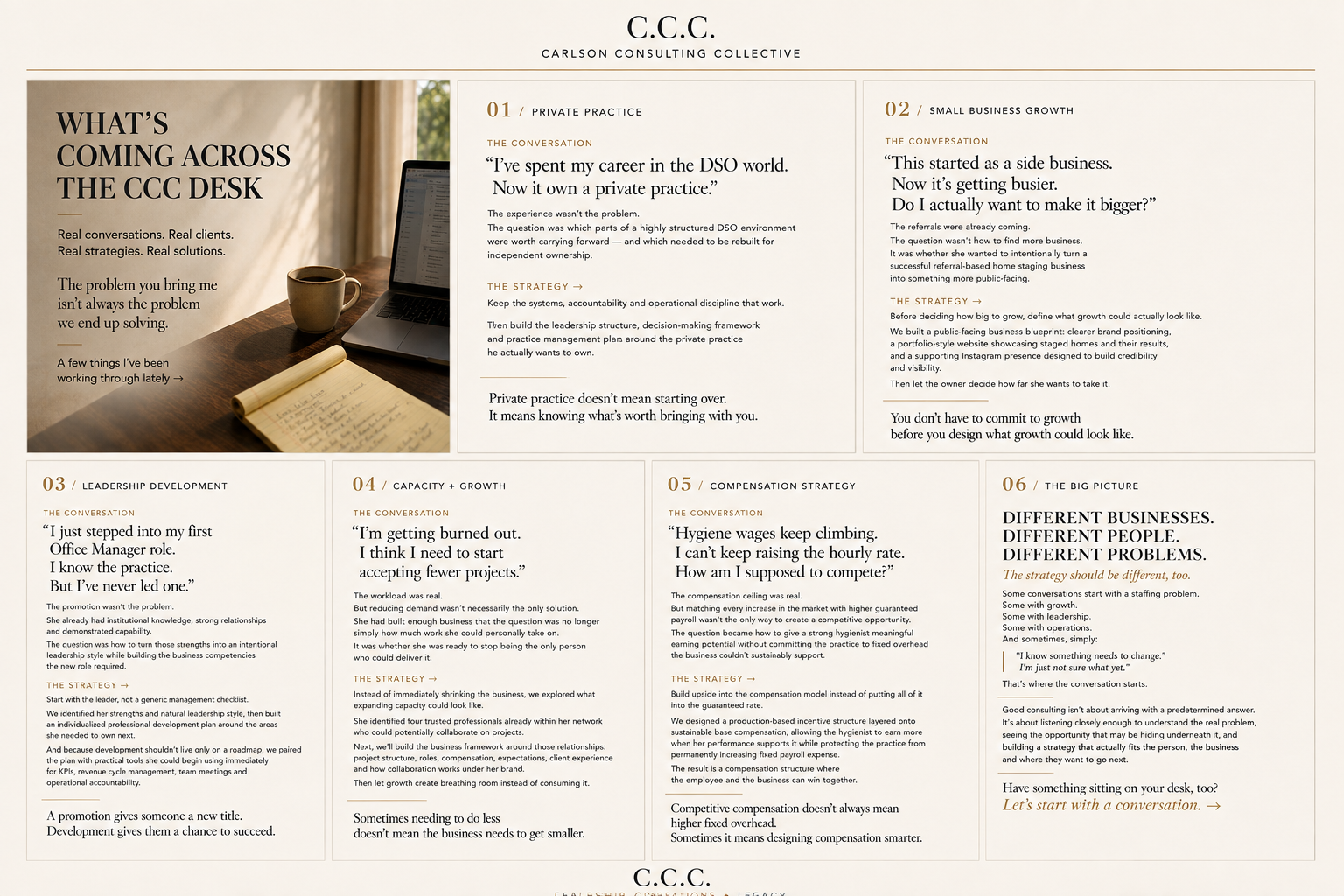
What’s Coming Across the CCC Desk
Real conversations. Real clients. Real strategies. Real solutions.
One of my favorite things about consulting is that the problem someone brings to the conversation isn’t always the problem we end up solving.
Sometimes a business owner comes to me with a staffing problem.
Sometimes it’s compensation.
Sometimes it’s growth.
Sometimes a new leader knows she needs support but isn’t quite sure what kind.
And sometimes the conversation starts with nothing more specific than:
“Something needs to change. I’m just not sure what yet.”
That’s enough.
Because good consulting doesn’t start with a predetermined solution. It starts with listening, asking better questions and understanding what is actually happening inside the business.
Here are five real conversations that have come across the Carlson Consulting Collective desk recently and where those conversations led.
01 | Moving From the DSO World to Private Practice
The conversation:
“I’ve spent my career in the DSO world. Now I own a private practice.”
There is an enormous amount of experience that comes from working within a highly structured organization. Systems. Accountability. Defined roles. Operational discipline. Established processes.
Private ownership doesn’t mean throwing all of that away.
The work became identifying which pieces were worth carrying forward and which needed to be rebuilt around the realities, goals and identity of an independently owned practice.
The strategy was not to start over.
It was to keep what worked and intentionally build the leadership structure, decision-making framework and practice management plan around the private practice he actually wants to own.
Private practice doesn’t mean starting over. It means knowing what’s worth bringing with you.
02 | When a Side Business Starts Becoming Something More
The conversation:
“This started as a side business. Now it’s getting busier. Do I actually want to make it bigger?”
This one started differently.
The business wasn’t struggling to find customers. Referrals were already happening.
The real question was whether the owner wanted to intentionally take a successful referral-based home staging business and make it more public-facing.
So instead of immediately talking about “growth,” we started defining what growth could actually look like.
A stronger brand identity.
A portfolio-style website capable of showcasing staged homes and their results.
A supporting Instagram presence that could build credibility and visibility.
A clearer public-facing business structure.
Then comes the important part:
The owner gets to decide how far she wants to take it.
You don’t have to commit to growth before you design what growth could look like.
Sometimes seeing the blueprint is what gives you enough information to decide whether you actually want to build it.
03 | A New Title Isn’t the Same as Leadership Development
The conversation:
“I just stepped into my first Office Manager role. I know the practice. But I’ve never led one.”
She already had institutional knowledge.
She had relationships.
She had demonstrated capability.
The promotion wasn’t the problem.
The opportunity was helping her turn those existing strengths into an intentional leadership style while developing the business competencies her new role required.
Rather than handing her a generic management checklist, we started with the leader herself.
What does she already do well?
How does she naturally communicate and lead?
Where does she need development?
What does she now need to understand about KPIs, revenue cycle management, team meetings, accountability and practice operations?
From there, we could build an individualized professional development plan and pair it with practical tools she could begin using immediately.
Because leadership development shouldn’t live exclusively on a roadmap.
It should start showing up in how someone leads today.
A promotion gives someone a new title. Development gives them a chance to succeed.
04 | When Burnout Might Actually Be a Capacity Problem
The conversation:
“I’m getting burned out. I think I need to start accepting fewer projects.”
The workload was real.
But reducing demand wasn’t necessarily the only answer.
She had built enough business that the question was becoming less about how much work she could personally take on and more about whether she still needed to be the only person capable of delivering it.
That changed the conversation.
Instead of immediately shrinking the business, we explored what expanding capacity could look like.
Within minutes, she identified four trusted professionals already in her network who could potentially collaborate with her on projects.
Now the next phase becomes building the business framework around those relationships: project structure, roles, compensation, expectations, client experience and what it means to collaborate under her brand.
Growth should not automatically mean doing more yourself.
Sometimes growth is what finally creates the breathing room.
Needing to do less doesn’t necessarily mean the business needs to get smaller.
05 | Competing on Compensation Without Breaking the Business
The conversation:
“Hygiene wages keep climbing. I can’t keep raising the hourly rate. How am I supposed to compete?”
The compensation ceiling was real.
But matching every increase in the employment market with permanently higher guaranteed payroll wasn’t the only possible solution.
The better question was:
How can we create meaningful earning potential for a strong employee while protecting the practice from fixed overhead it cannot sustainably support?
That led us toward a compensation structure that creates upside through performance rather than putting the entire burden into the guaranteed hourly rate.
The goal is not simply to pay more.
It’s to design compensation intelligently enough that excellent performance creates an opportunity for the employee and the business to win together.
Competitive compensation doesn’t always mean higher fixed overhead. Sometimes it means designing compensation smarter.
The Bigger Picture
Different businesses.
Different people.
Different problems.
The strategy should be different, too.
There is a temptation in business consulting to arrive with a framework and immediately start looking for somewhere to apply it.
I prefer the opposite approach.
Start with the conversation.
Listen closely enough to understand the problem someone believes they have.
Ask enough questions to understand what is happening underneath it.
Identify the opportunity that might not have been obvious when the conversation started.
And then build the strategy around the actual person, business, resources and goals sitting in front of you.
Sometimes the answer is a system.
Sometimes it’s a leadership plan.
Sometimes it’s an operational change.
Sometimes it’s a completely different way of looking at the original problem.
And sometimes the most valuable moment in the entire conversation is realizing:
Maybe we’ve been trying to solve the wrong thing.
That is the work I love.
Have something sitting on your desk, too?
You don’t need to know exactly what service you need.
You don’t need to arrive with the solution.
You don’t even need to be completely certain what the problem is yet.
Bring the conversation. We’ll start there.
Carlson Consulting Collective LLC
Leadership • Operations • Legacy